Tesla may be laying early groundwork for a future where cars stay connected almost everywhere, not just in cities, but across highways, deserts, and rural regions with weak cellular coverage. Here’s a quick look at an X post showing a page from a patent application. It describes an RF-transparent roof design that lets satellite and cellular communication equipment be built directly into a vehicle’s structure.
On the surface, this looks like a materials or design upgrade. But when you look closer, it hints at something bigger: vehicles that can seamlessly switch between cellular and satellite networks, potentially including Starlink’s direct-to-cell (D2C) service.
The U.S. patent document isn’t currently available online right now, but the European filing is, and it includes the same key details.
1. Many Cars May Already Be “Satellite-Ready”
One of the most overlooked details in this discussion is the hardware already inside many modern vehicles.
- Many newer cars ship with 5G modems that support Band 25 in North America.
- In the U.S., SpaceX is working on direct-to-phone connections using specific radio frequencies. These include 1910–1915 MHz for signals sent from Earth to space, and 1990–1995 MHz for signals sent from space back to Earth for everyday devices.
- This suggests some vehicles may already be technically compatible with satellite connectivity, at least at a foundational level.
An example of an automotive 5G modem, the AG55xQ North America variant, includes support for LTE Band 25 in its list of frequency bands.
That doesn’t mean cars can suddenly talk to satellites without changes. Antennas, signal processing, and power management still matter. But it does mean the gap may be smaller than expected. Instead of adding bulky external hardware, the transition could happen through smarter integration and software updates.
This is where Tesla’s RF-transparent roof becomes important. Traditional vehicle materials can block or degrade radio signals. A roof designed to allow radio frequencies to pass through cleanly creates space for embedded antennas, without changing how the car looks or drives.
2. Does This Eliminate the Need for a Starlink Dish?
A common question is whether this means vehicles won’t need a Starlink Mini dish at all. In short: possibly, but not for every use case.
Starlink’s direct-to-cell service is designed for:
- Messaging
- Basic data
- Low-bandwidth connectivity in remote areas
It is not meant to replace high-throughput satellite terminals used for homes or RVs. For vehicles, though, the goal isn’t streaming movies at highway speeds. It’s about reliable, always-available communication.
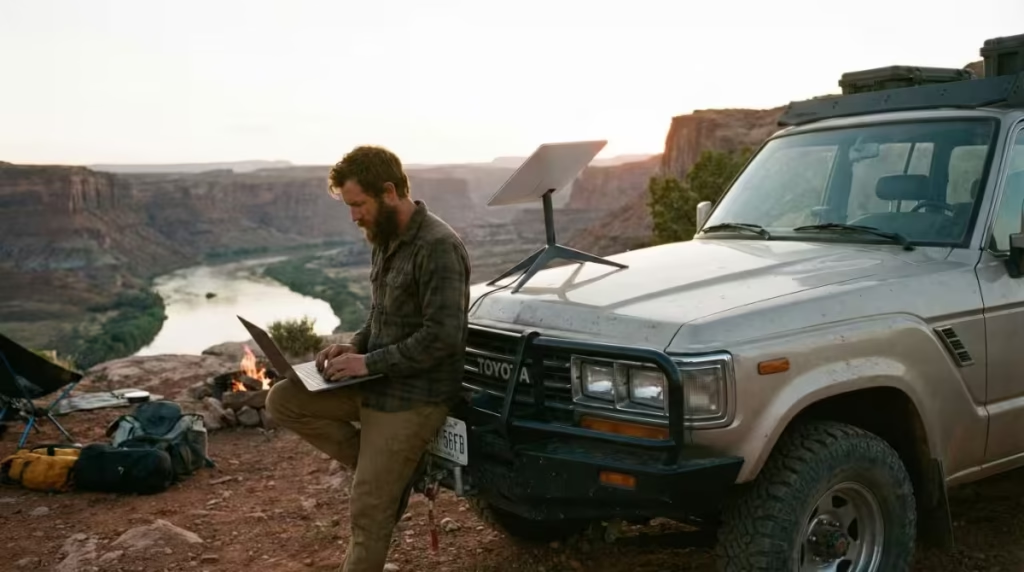
If a car can send and receive essential data, location, alerts, and diagnostics through satellites when cellular coverage drops, that already changes the game. For many drivers, this could remove the need for any external dish entirely.
So far, the biggest confirmed step is satellite messaging that works with regular 4G LTE phones. More services are planned and will be added over time.
3. The Hard Limits of Satellite Connectivity
Satellite coverage isn’t magic, and Tesla’s patent doesn’t change physics.
There are real constraints:
- Tunnels block satellite signals
- Underground parking garages cut off direct sky access
- Dense urban environments can interfere with line-of-sight connections
This is why the future isn’t “satellite instead of cellular,” but satellite working alongside cellular and local networks. The real innovation will be in seamless handoff, where the car switches networks automatically without the driver noticing.
Think of it like Wi-Fi and cellular on a phone. You don’t manage it manually; the system decides what works best in the moment. Vehicles will need the same intelligence, but across more network types.
4. Always-On Connectivity Changes Vehicle Safety
One of the most compelling implications is vehicle-to-vehicle communication.
With continuous connectivity:
- Cars could share sudden braking events
- Hazard warnings could propagate beyond visual range
- Accident data could alert nearby vehicles in real time
This doesn’t rely on every car being autonomous. Even human-driven vehicles benefit when information travels faster than the line of sight. Satellite connectivity expands the radius of awareness, especially in rural or low-coverage areas where accidents are more likely to go unnoticed.
Over time, this kind of data sharing could reduce chain-reaction crashes and improve response times for emergencies.
Why Tesla’s Approach Looks Strategic
Tesla rarely introduces technology without a long-term system view. An RF-transparent roof isn’t just about connectivity, it’s about future-proofing.
As software-defined vehicles evolve:
- Communication becomes as critical as propulsion
- Updates, diagnostics, and safety systems depend on reliable links
- Global connectivity simplifies regional hardware differences
By embedding connectivity into the vehicle’s structure, Tesla avoids bolt-on solutions and keeps design clean. It also positions the company to adapt as satellite networks mature and bandwidth improves.
The Bigger Picture
This patent doesn’t confirm that Tesla vehicles will be fully Starlink-connected tomorrow. But it does show early alignment between vehicle design and satellite-cellular convergence.
The takeaway is not hype, it’s trajectory.
Cars are becoming networked platforms, not isolated machines. As satellite and cellular systems converge, vehicles that can tap into both will be safer, more reliable, and more resilient to coverage gaps.
Tesla’s latest patent suggests the company understands that the future is coming and is quietly building toward it.